Ross Garnaut is probably the best known Australian economist working in Australia (Geoff Harcourt is the best Australian economist, but is at Cambridge). Garnaut has the ability to pinpoint the real issues facing Australia, as he did with climate change.
He has now entered the debate about the great danger that faces the Australian economy, namely it is high wage and low productivity and there has to be a unified and bipartisan approach to solving this.
The article below was motivated by Maurice Newman's contention that its all the fault of a high minimum wage in Australia. Newman is an adviser to the idiot Abbott and a climate change denier and represents the sort of partisan politics that Garnaut is arguing has got to stop.
Lets deal with productivity first. Productivity is a measure of efficiency, how much of an input has to be used to produce a given amount of output. The higher the level of productivity the higher the level of wages that can be afforded. Productivity is raised by investment in capital and people and using resources to their maximum potential.
Australian's are complacent about the challenges of the future according to Garnaut. They want higher wages but are not prepared to make the changes necessary to raise productivity. He blames the pursuit of self interest by unions and employers and the disfunctional process of government.
Newman on the other hand wants the minimum wage to be lowered to make it cheaper for firms to employ people. He also wants lower taxes on firms. Both raise profits.
The contrast between the approach of the academic, Garnaut, and the vested interest of business, Newman, is something those studying Economics must be able to distinguish between.
The data in the article on Newman shows that Australia does have a high minimum wage. It's Australian to aim for greater equality and such a choice is quite reasonable by a society. But that does not mean people can simply sit back and enjoy the them, they have to justify the high wages with high productivity.
Just to be clear this is not just the fault of business as represented by Newman. The 'new Founders building' would have been ready for the start of Term 4 in Europe, but union intransigence on work practices means it will be a close run thing for Term 1.
Friday, 15 November 2013

Saturday, 9 November 2013
Rare sense from the Coalition on borrowing
The Coalition made a great show of claiming the budget was in crisis for the last five years. While this was simply (bad) politics it has clouded the issue to a dangerous degree as people believed the propaganda.
Now the Government are considering the very sensible move of distinguishing between borrowing to fund investment and borrowing to pay everyday bills. This is quite normal in other countries.
The argument works like this. If you borrow money and buy ice cream then you are simply funding consumption today and will have to pay back later. But you have nothing to show for your borrowing except a bigger waistline.
If you borrow to buy a business then you are borrowing to fund future consumption. While you have to pay back the loan you have bought an income stream to do that and make a profit.
For the government it is a similar story. If they borrow to pay the wages of government employees and to subsidise prescription drugs then they are buying ice cream. It does somebody some good now but you have to pay it back later which means higher taxes.
When the government funds infrastructure spending through borrowing they are adding to the capital stock of the nation. It allows businesses to operate more efficiently and competitively. The government has given the economy the chance to grow more quickly than it otherwise would. The higher taxes paid by individuals and firms in the future pays back the borrowing.
The NBN, new railways and ports are all good examples of infrastructure spending, while higher spending on schools and universities adds to human capital. They all add to Australia's ability to produce goods and services at competitive prices.
From this it follows that borrowing for infrastructure is good, providing the benefits outweigh the costs. In a modern economy the government should always be in debt to fund infrastructure projects as part of a long term supply side policy.
Therefore the stupid contest between political parties to return to an overall surplus faster than the other is fundamentally flawed. The change to distinguishing between a deficit to fund current spending and capital spending needs to be done and Joe Hockey will have to explain this to the idiot Abbot in words of a few syllables.
Now the Government are considering the very sensible move of distinguishing between borrowing to fund investment and borrowing to pay everyday bills. This is quite normal in other countries.
The argument works like this. If you borrow money and buy ice cream then you are simply funding consumption today and will have to pay back later. But you have nothing to show for your borrowing except a bigger waistline.
If you borrow to buy a business then you are borrowing to fund future consumption. While you have to pay back the loan you have bought an income stream to do that and make a profit.
For the government it is a similar story. If they borrow to pay the wages of government employees and to subsidise prescription drugs then they are buying ice cream. It does somebody some good now but you have to pay it back later which means higher taxes.
When the government funds infrastructure spending through borrowing they are adding to the capital stock of the nation. It allows businesses to operate more efficiently and competitively. The government has given the economy the chance to grow more quickly than it otherwise would. The higher taxes paid by individuals and firms in the future pays back the borrowing.
The NBN, new railways and ports are all good examples of infrastructure spending, while higher spending on schools and universities adds to human capital. They all add to Australia's ability to produce goods and services at competitive prices.
From this it follows that borrowing for infrastructure is good, providing the benefits outweigh the costs. In a modern economy the government should always be in debt to fund infrastructure projects as part of a long term supply side policy.
Therefore the stupid contest between political parties to return to an overall surplus faster than the other is fundamentally flawed. The change to distinguishing between a deficit to fund current spending and capital spending needs to be done and Joe Hockey will have to explain this to the idiot Abbot in words of a few syllables.
Thursday, 7 November 2013
The dangers of not competing
Qantas have announced they will stop maintaining aircraft at Avalon. Despite the protests of the engineers they have themselves to blame to some degree.
The decision will mean that part of the Qantas fleet will be maintained abroad where it is much cheaper to do so. While this is unfortunate, especially for Geelong who might welcome Australia's first nuclear power plant right now, it is an illustration of the benefits of trade.
As Qantas will be able to save money on maintenance by this move they will be able to charge lower fares. Those lower fares will benefit Qantas consumers directly and other passengers as it adds to competition in the market.
There is no point complaining about lower wages abroad or lower quality (first may be true but the second isn't). The fact is that countries should specialise in what they are comparatively best at and import the rest. In the long run nobody wins by subsidising uneconomic industries, the taxpayers and consumers pay more for a brief period of higher wages and employment for the inefficient.
The actual answer is to invest in human capital via education and training to make Australia competitive in the high tech, knowledge based industries that will allow Australians to maintain their standard of living. The alternative is to drop living standards to those of the bulk of the Asian Pacific region. There will be few takers for that.
The decision will mean that part of the Qantas fleet will be maintained abroad where it is much cheaper to do so. While this is unfortunate, especially for Geelong who might welcome Australia's first nuclear power plant right now, it is an illustration of the benefits of trade.
As Qantas will be able to save money on maintenance by this move they will be able to charge lower fares. Those lower fares will benefit Qantas consumers directly and other passengers as it adds to competition in the market.
There is no point complaining about lower wages abroad or lower quality (first may be true but the second isn't). The fact is that countries should specialise in what they are comparatively best at and import the rest. In the long run nobody wins by subsidising uneconomic industries, the taxpayers and consumers pay more for a brief period of higher wages and employment for the inefficient.
The actual answer is to invest in human capital via education and training to make Australia competitive in the high tech, knowledge based industries that will allow Australians to maintain their standard of living. The alternative is to drop living standards to those of the bulk of the Asian Pacific region. There will be few takers for that.
Wednesday, 6 November 2013
Unemployment at 5.7%
Australia's latest unemployment figures released today show 5.7% of the workforce as unemployed. Depending on how you look at it that's up 0.1% or steady because last months figure was revised upwards to 5.7%.
The real worry is that jobs are not being created very quickly. There was a net rise of about 1000 jobs if you accept part-time jobs, which rose, to be as useful as full time jobs, which fell. Of course nobody does see them as equivalent so there was really a net fall in employment.
The participation rate also fell to 64.8%. While this is the lowest level since 2006 a quick look at the chart in the ABC News report shows that while there is a slight trend downwards this is not severe and may well indicate the relatively high level of unemployment and scarcity of full time jobs has put some job seekers off for now.
Australia considers 5% unemployment as 'full employment'. That's quite a high level to accept as full employment, but few OECD countries are achieving 5.7% let alone 5%. Use the link to the map below to see where Australia ranks (hover over a country to get the data).
Australia should be concerned about unemployment. Those unemployed suffer a lower standard of living and impose costs upon the economy and taxpayers. Rising unemployment also indicates slow growth and possibly skill shortages among the available workforce. If the upward trend in unemployment, which started in early 2012, continues it will require further policy measures to boost growth.

The real worry is that jobs are not being created very quickly. There was a net rise of about 1000 jobs if you accept part-time jobs, which rose, to be as useful as full time jobs, which fell. Of course nobody does see them as equivalent so there was really a net fall in employment.
The participation rate also fell to 64.8%. While this is the lowest level since 2006 a quick look at the chart in the ABC News report shows that while there is a slight trend downwards this is not severe and may well indicate the relatively high level of unemployment and scarcity of full time jobs has put some job seekers off for now.
Australia considers 5% unemployment as 'full employment'. That's quite a high level to accept as full employment, but few OECD countries are achieving 5.7% let alone 5%. Use the link to the map below to see where Australia ranks (hover over a country to get the data).
Australia should be concerned about unemployment. Those unemployed suffer a lower standard of living and impose costs upon the economy and taxpayers. Rising unemployment also indicates slow growth and possibly skill shortages among the available workforce. If the upward trend in unemployment, which started in early 2012, continues it will require further policy measures to boost growth.

Tuesday, 5 November 2013
Coalition sets confused message on budget, but confirms CEDA's concern
Today Joe Hockey, The Federal Treasurer, dropped tax increases which will cost the government $3.1billion. This is despite the fact that there was a 'budget crisis' according to the Coalition during the election campaign.
The taxes dropped are a mixture of measures, but on the whole the Treasurer has pandered to vested interest. It is perhaps no coincidence that today CEDA (Committee for Economics Development of Australia) issued a report calling for a reform of the tax system, measures to improve productivity and an end to subsidies that maintain poorly performing industries that can't compete without state help.
Hockey has stated he will repeal the Mining Resources Rent Tax, largely to placate the powerful mining lobby. Taxes on Economic Rent are one of the few taxes that have no impact on output and are seen as unambiguously good and fair. He has also decided not to introduce changes to Fringe Benefit Tax which helps the car industry by legalising tax evasion.
There are two key issues to consider:
1. Is there really a budget emergency?
2. Is there any political will to simplify and improve Australia's tax system?
1. The obvious answer is no. Australia has a very small deficit on its budget and very low National Debt. The current deficit could be sustained indefinitely without any trouble whatsoever.
2. This too is a no. The Henry Commission suggested sensible reforms to the tax system which were basically ignored. The problem is that Australian politicians are weak and more concerned with keeping power than dealing with real problems. Every tax concession, however unjustifiable, loses somebody's vote and rarely gains as many.
It is not possible to do justice to the issued raised in a single post. However there are many questions to take up over the coming year before the next VCE exam.

The taxes dropped are a mixture of measures, but on the whole the Treasurer has pandered to vested interest. It is perhaps no coincidence that today CEDA (Committee for Economics Development of Australia) issued a report calling for a reform of the tax system, measures to improve productivity and an end to subsidies that maintain poorly performing industries that can't compete without state help.
Hockey has stated he will repeal the Mining Resources Rent Tax, largely to placate the powerful mining lobby. Taxes on Economic Rent are one of the few taxes that have no impact on output and are seen as unambiguously good and fair. He has also decided not to introduce changes to Fringe Benefit Tax which helps the car industry by legalising tax evasion.
There are two key issues to consider:
1. Is there really a budget emergency?
2. Is there any political will to simplify and improve Australia's tax system?
1. The obvious answer is no. Australia has a very small deficit on its budget and very low National Debt. The current deficit could be sustained indefinitely without any trouble whatsoever.
2. This too is a no. The Henry Commission suggested sensible reforms to the tax system which were basically ignored. The problem is that Australian politicians are weak and more concerned with keeping power than dealing with real problems. Every tax concession, however unjustifiable, loses somebody's vote and rarely gains as many.
It is not possible to do justice to the issued raised in a single post. However there are many questions to take up over the coming year before the next VCE exam.

Australia's Debt is low by international standards. Source: ABC
Monday, 4 November 2013
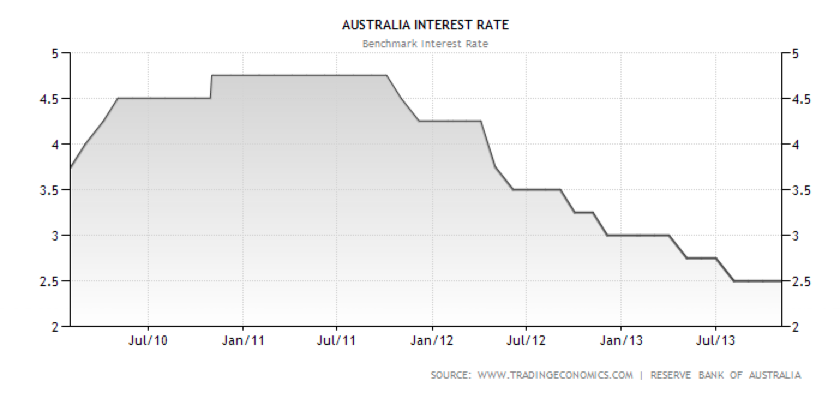
Cash rate on hold, but a war of words on the exchange rate
The RBA kept the cash rate on hold today. This was expected, despite the latest inflation rate figures being slightly higher than expected.
The RBA have tended to over react to inflation figures in the last eighteen months, which is odd because they know interest rates take up to two years to affect the headline inflation rate. On this occasion other considerations may have outweighed inflation concerns.
The RBA are worried about the future growth of the economy. The mining sector is investing less and the fall in commodity prices means that export values are falling. Together that means lower Aggregate Demand and so lower inflationary pressure in the medium term.
The non-mining sector has to provide the growth which is necessary to maintain employment. A key issue for the non-mining economy is the exchange rate. The resources boom pushed the exchange rate up, made imports cheaper and exports more expensive for foreigners.
Now the exchange rate needs to fall to help the non-mining sector grow. Imports will be less competitive and exports cheaper allowing a boost to Aggregate Demand (assuming the Marshall-Lerner conditions hold).
The RBA could lower interest rates to help make the $Aus less attractive to hold (as relative exchange rates abroad stay the same). Instead they have opted to 'talk down' the $Aus in order to achieve the lower exchange rate. They clearly indicate that a lower interest rate will be set next year, which should lead to a fall in the exchange rate. But now the $Aus should fall on the expectation of this change. Why hold Australian dollars until they fall in value when you can sell now?
So the RBA can eat their cake and have it. They maintain anti-inflationary pressure by not lowering interest rates and get a a lower exchange rate to help boost growth. Let's hope it works.
The RBA have tended to over react to inflation figures in the last eighteen months, which is odd because they know interest rates take up to two years to affect the headline inflation rate. On this occasion other considerations may have outweighed inflation concerns.
The RBA are worried about the future growth of the economy. The mining sector is investing less and the fall in commodity prices means that export values are falling. Together that means lower Aggregate Demand and so lower inflationary pressure in the medium term.
The non-mining sector has to provide the growth which is necessary to maintain employment. A key issue for the non-mining economy is the exchange rate. The resources boom pushed the exchange rate up, made imports cheaper and exports more expensive for foreigners.
Now the exchange rate needs to fall to help the non-mining sector grow. Imports will be less competitive and exports cheaper allowing a boost to Aggregate Demand (assuming the Marshall-Lerner conditions hold).
The RBA could lower interest rates to help make the $Aus less attractive to hold (as relative exchange rates abroad stay the same). Instead they have opted to 'talk down' the $Aus in order to achieve the lower exchange rate. They clearly indicate that a lower interest rate will be set next year, which should lead to a fall in the exchange rate. But now the $Aus should fall on the expectation of this change. Why hold Australian dollars until they fall in value when you can sell now?
So the RBA can eat their cake and have it. They maintain anti-inflationary pressure by not lowering interest rates and get a a lower exchange rate to help boost growth. Let's hope it works.
Wednesday, 30 October 2013
A worrying development
Demand and supply analysis is vital to understanding Units 1 and 3. here is a story about a possible wine shortage - which worries me especially.
The obvious questions are:
What will happen in the wine market?
Will the short term and long term effects be different?
The obvious questions are:
What will happen in the wine market?
Will the short term and long term effects be different?
Subscribe to:
Posts (Atom)