Showing posts with label RBA. Show all posts

Thursday, 15 January 2015

Monetary policy in 2015

The role of the Reserve Bank of Australia (RBA) in monetary policy is to maintain the rate of inflation, on average, at 2% to 3% over the economic cycle.

The tool that the RBA has to achieve this is the interest rate (cash rate). They can adjust the cash rate to influence the level of Aggregate Demand in the economy. Lower interest rates encourage consumption, investment and exports (through a lower exchange rate). The higher the level of Aggregate Demand the greater is the upward pressure on inflation. 

So the RBA monitors the level of economic activity in the economy (such as the rate of growth of GDP and other indicators of Aggregate Demand such as consumer spending) and attempts to set interest rates so that inflation meets its target.

The article below looks at the likelihood of an interest rate cut in Australia soon. This is based on low inflationary pressures particularly the fall in oil prices and the fall in the rate of activity in the construction industry. 

There are many influences on the rate of inflation, often these influences conflict (a mixture of 'headwinds' and 'tailwinds'), but at present the overall effect seems to be for lower inflation. That demands an interest rate cut to encourage higher Aggregate Demand.


The Guardian article is here

Greg Jericho's summary of important changes in the Australian economy in 2014 is below, which gives some wider context.

Monday, 4 November 2013

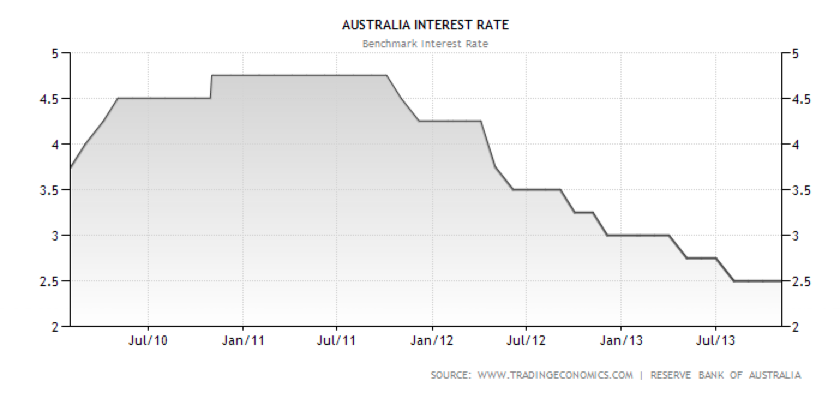
Cash rate on hold, but a war of words on the exchange rate

The RBA kept the cash rate on hold today. This was expected, despite the latest inflation rate figures being slightly higher than expected.

The RBA have tended to over react to inflation figures in the last eighteen months, which is odd because they know interest rates take up to two years to affect the headline inflation rate. On this occasion other considerations may have outweighed inflation concerns.

The RBA are worried about the future growth of the economy. The mining sector is investing less and the fall in commodity prices means that export values are falling. Together that means lower Aggregate Demand and so lower inflationary pressure in the medium term.

The non-mining sector has to provide the growth which is necessary to maintain employment. A key issue for the non-mining economy is the exchange rate. The resources boom pushed the exchange rate up, made imports cheaper and exports more expensive for foreigners.

Now the exchange rate needs to fall to help the non-mining sector grow. Imports will be less competitive and exports cheaper allowing a boost to Aggregate Demand (assuming the Marshall-Lerner conditions hold).

The RBA could lower interest rates to help make the $Aus less attractive to hold (as relative exchange rates abroad stay the same). Instead they have opted to 'talk down' the $Aus in order to achieve the lower exchange rate. They clearly indicate that a lower interest rate will be set next year, which should lead to a fall in the exchange rate. But now the $Aus should fall on the expectation of this change. Why hold Australian dollars until they fall in value when you can sell now?

So the RBA can eat their cake and have it. They maintain anti-inflationary pressure by not lowering interest rates and get a a lower exchange rate to help boost growth. Let's hope it works.

Saturday, 2 March 2013

Operating monetary policy

I know this is not a subject anyone is studying at this point in the year, but Ross Gittins outlines how monetary policy works in today's Age.

Exactly how the Reserve Bank of Australia (RBA) controls interest rates is something you have to understand in Unit 4. Australia does this in a similar way to other countries, but has its own precise way of doing it.

Ross Gittins can write some really useful stuff and following his column is a good idea. (However sometimes he seems to get it off the back of a cereal packet so be careful!)

I have one argument with Gittins assertion that the RBA is in control of interest rates. His analysis works for Australia, so far. If he was talking about the UK or the Euro Area, for example, then it would have to be conceded that the market rate can diverge from the 'official rate'.

This happens because funds move between financial markets as banks operate across borders. Australia is a small and isolated market, but it becomes less isolated everyday and before long international banks will be operating alongside the high street banks you know well. But not before you do your exams.