The Quarterly Statement of the RBA has painted a gloomy picture of the economy. Unemployment is forecast to stay high for two years and the rate of growth will be just below trend. Inflation is forecast to be just 2% rather than the 2.75% previously predicted, mainly due to the repeal of the Carbon Tax.
Note that the repeal of the carbon tax does not reduce core (underlying) inflation, only headline inflation as it won't be repeated and will drop out of the index after a year.
The overall implication is that interest rates won't be rising any time soon and this might help bring the exchange rate down. Such a downward movement will be welcomes to exporters.
The Guardian article outlines the main points and contains essential figures to remember!
Showing posts with label Growth. Show all posts
Showing posts with label Growth. Show all posts
Friday, 8 August 2014

Tuesday, 4 March 2014
Good economic news?
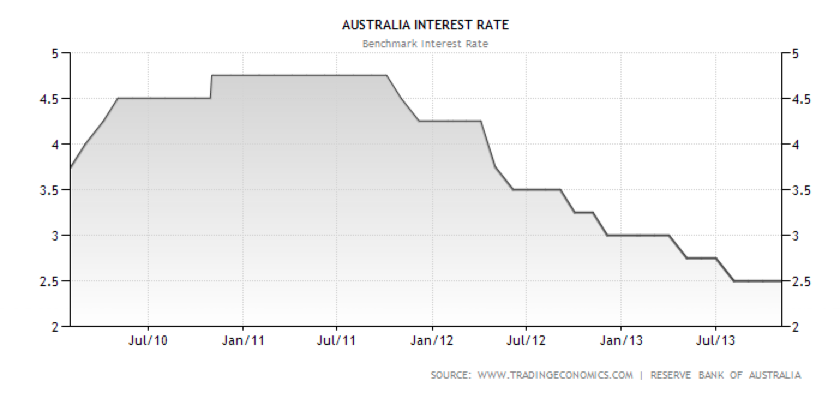
Yesterday the reserve bank of Australia left interest rates at 2.5%, a record low for Australia. there was also news that Australia grew by 0.8% last quarter (3 months), faster than was expected.
The RBA feel that export growth will continue, but wish to remain accommodating as the rest of the economy grew only slowly. Interesting despite low interest rates borrowing is not growing strongly and this may indicate weak confidence among firms and consumers.
There is little doubt that unemployment will continue to rise, probably for the rest of the year, but the lower dollar is helping exports (as a lower exchange rate causes export prices to fall). The RBA would, however, still like to see the dollar even weaker (perhaps as low as 80c to the USdollar.
Below are articles on the rate decision and the growth figures.
The RBA feel that export growth will continue, but wish to remain accommodating as the rest of the economy grew only slowly. Interesting despite low interest rates borrowing is not growing strongly and this may indicate weak confidence among firms and consumers.
There is little doubt that unemployment will continue to rise, probably for the rest of the year, but the lower dollar is helping exports (as a lower exchange rate causes export prices to fall). The RBA would, however, still like to see the dollar even weaker (perhaps as low as 80c to the USdollar.
Below are articles on the rate decision and the growth figures.
Wednesday, 6 November 2013
Unemployment at 5.7%
Australia's latest unemployment figures released today show 5.7% of the workforce as unemployed. Depending on how you look at it that's up 0.1% or steady because last months figure was revised upwards to 5.7%.
The real worry is that jobs are not being created very quickly. There was a net rise of about 1000 jobs if you accept part-time jobs, which rose, to be as useful as full time jobs, which fell. Of course nobody does see them as equivalent so there was really a net fall in employment.
The participation rate also fell to 64.8%. While this is the lowest level since 2006 a quick look at the chart in the ABC News report shows that while there is a slight trend downwards this is not severe and may well indicate the relatively high level of unemployment and scarcity of full time jobs has put some job seekers off for now.
Australia considers 5% unemployment as 'full employment'. That's quite a high level to accept as full employment, but few OECD countries are achieving 5.7% let alone 5%. Use the link to the map below to see where Australia ranks (hover over a country to get the data).
Australia should be concerned about unemployment. Those unemployed suffer a lower standard of living and impose costs upon the economy and taxpayers. Rising unemployment also indicates slow growth and possibly skill shortages among the available workforce. If the upward trend in unemployment, which started in early 2012, continues it will require further policy measures to boost growth.

The real worry is that jobs are not being created very quickly. There was a net rise of about 1000 jobs if you accept part-time jobs, which rose, to be as useful as full time jobs, which fell. Of course nobody does see them as equivalent so there was really a net fall in employment.
The participation rate also fell to 64.8%. While this is the lowest level since 2006 a quick look at the chart in the ABC News report shows that while there is a slight trend downwards this is not severe and may well indicate the relatively high level of unemployment and scarcity of full time jobs has put some job seekers off for now.
Australia considers 5% unemployment as 'full employment'. That's quite a high level to accept as full employment, but few OECD countries are achieving 5.7% let alone 5%. Use the link to the map below to see where Australia ranks (hover over a country to get the data).
Australia should be concerned about unemployment. Those unemployed suffer a lower standard of living and impose costs upon the economy and taxpayers. Rising unemployment also indicates slow growth and possibly skill shortages among the available workforce. If the upward trend in unemployment, which started in early 2012, continues it will require further policy measures to boost growth.

Monday, 4 November 2013
Cash rate on hold, but a war of words on the exchange rate
The RBA kept the cash rate on hold today. This was expected, despite the latest inflation rate figures being slightly higher than expected.
The RBA have tended to over react to inflation figures in the last eighteen months, which is odd because they know interest rates take up to two years to affect the headline inflation rate. On this occasion other considerations may have outweighed inflation concerns.
The RBA are worried about the future growth of the economy. The mining sector is investing less and the fall in commodity prices means that export values are falling. Together that means lower Aggregate Demand and so lower inflationary pressure in the medium term.
The non-mining sector has to provide the growth which is necessary to maintain employment. A key issue for the non-mining economy is the exchange rate. The resources boom pushed the exchange rate up, made imports cheaper and exports more expensive for foreigners.
Now the exchange rate needs to fall to help the non-mining sector grow. Imports will be less competitive and exports cheaper allowing a boost to Aggregate Demand (assuming the Marshall-Lerner conditions hold).
The RBA could lower interest rates to help make the $Aus less attractive to hold (as relative exchange rates abroad stay the same). Instead they have opted to 'talk down' the $Aus in order to achieve the lower exchange rate. They clearly indicate that a lower interest rate will be set next year, which should lead to a fall in the exchange rate. But now the $Aus should fall on the expectation of this change. Why hold Australian dollars until they fall in value when you can sell now?
So the RBA can eat their cake and have it. They maintain anti-inflationary pressure by not lowering interest rates and get a a lower exchange rate to help boost growth. Let's hope it works.
The RBA have tended to over react to inflation figures in the last eighteen months, which is odd because they know interest rates take up to two years to affect the headline inflation rate. On this occasion other considerations may have outweighed inflation concerns.
The RBA are worried about the future growth of the economy. The mining sector is investing less and the fall in commodity prices means that export values are falling. Together that means lower Aggregate Demand and so lower inflationary pressure in the medium term.
The non-mining sector has to provide the growth which is necessary to maintain employment. A key issue for the non-mining economy is the exchange rate. The resources boom pushed the exchange rate up, made imports cheaper and exports more expensive for foreigners.
Now the exchange rate needs to fall to help the non-mining sector grow. Imports will be less competitive and exports cheaper allowing a boost to Aggregate Demand (assuming the Marshall-Lerner conditions hold).
The RBA could lower interest rates to help make the $Aus less attractive to hold (as relative exchange rates abroad stay the same). Instead they have opted to 'talk down' the $Aus in order to achieve the lower exchange rate. They clearly indicate that a lower interest rate will be set next year, which should lead to a fall in the exchange rate. But now the $Aus should fall on the expectation of this change. Why hold Australian dollars until they fall in value when you can sell now?
So the RBA can eat their cake and have it. They maintain anti-inflationary pressure by not lowering interest rates and get a a lower exchange rate to help boost growth. Let's hope it works.
Monday, 8 October 2012
China - the most important demand side factor
The main driver of the Australian economy recently has been the mining boom, caused by very strong exports to China. China has experienced nearly a decade of growth rates above 10% and that demanded a great deal of mineral resources.
Now the Chinese economy is growing more slowly. It's still growing, but now by only 7.2% a year. But that's still growth isn't it?
Chinese growth demanded a great deal from the mineral suppliers of the world and supply constraints meant that the prices of commodities rose quickly. Australia saw the Terms of Trade rise substantially and that made Australia a lot better off. The Mining Resources Boom.
Today most mineral producers have expanded capacity compared to just four years ago. Australia has developed mines, opened new ones and improved port and railway facilities to allow the export of more mineral resources. World supply has expanded.
But now Chinese growth is slowing and demand for mineral resources is moderating. Mineral prices are falling as the graph of the iron ore price shows.
This means a lower value of exports for Australia, and a falling Terms of Trade. Whatever way you look at it the demand side of the economy is weakening.
This means lower Exports and Investment (as the 'Age' article linked below shows a port development has been shelved) and so lower Aggregate Demand. The multiplier effect will cause National Income to fall further and this means fewer jobs.
Last year everyone thought the Terms of Trade (then at a record high) would feature in the exam. You would be very brave not to revise this topic for 2013.
Subscribe to:
Posts (Atom)