Showing posts with label Regressive taxation. Show all posts

Monday, 30 May 2016

Sugar tax - flawed thinking?

As IB students approach their first IA I'm posting this story to remind you about the UK 'Sugar tax'.

The article focuses on a group, "The Taxpayers Alliance", who oppose the tax (very Australian - any tax is a bad tax attitude). They point out that the tax is not being applied to all drinks with high sugar content.  They also suggest that the tax is regressive.

A sugar tax intends to address a negative externality of consumption and was dealt with in a post on 19th February. However the economics of it is shown in the diagram below. People don't understand how their consumption of the good is not as good for society (and them) as their perceived private benefit.

The first point made by the group is that the tax is not being applied to other sugary drinks. This is a fair point in some respects. Perhaps those who drink fizzy sugary drinks will switch to untaxed drinks due to the change in relative prices. This expose an important flaw in taxation policy, and suggests that applying the tax across a wider range of goods might be advisable.

However the criticism miss the point. Young people (and some older ones) can drink litres of fizzy drinks, but are unlikely to drink litres of hot chocolate. The problem is not the sugar content per 100ml, but the amount consumed. So if people swap a litre of fizzy drink for a hot chocolate then less sugar is consumed.

The second point made is that the tax is regressive. This means that the poorer households pay a higher proportion of their income in tax than richer households. This is usually true of specific indirect taxes. Should we be worried about this? In short, probably not. The sugar tax is designed to change behaviour. If households buy fewer fizzy drinks then they don't pay the tax and that's what the government wanted. If they carry on buying fizzy drinks then they are paying more towards their medical treatment.

Maybe the Taxpayers Alliance should have claimed the elasticity of demand was not conducive to reducing consumption instead?


This article is more relevant to IB students because of its international nature. However VCE students should be aware of the impact of, justification for and limitations of indirect tax.

Monday, 25 January 2016

Tax reform is a current issue

The Australian government has a budget problem. It's not always the problem they claim it to be so quickly here are the key problems:

1. The government does not raise enough money.  All budgets are a balance between income and revenue. Presently there is a budget deficit because successive Australian governments cut taxes and allowed some groups to have tax concessions which are politically difficult to remove.

2. The population of Australia is ageing. This will lead to the need to higher government spending in the future on services such as health and on benefit payments, such as pensions. There is also the likelihood that the working population will shrink, meaning fewer workers are available to pay the tax needed to raise revenue.

3. Commodity prices are falling. Australia relies on commodity exports to maintain its standard of living. The collapse in iron ore and coal prices means both Australia income and government tax revenue is falling.

Therefore action must be taken to establish a guaranteed revenue stream for the government. Reforming Australia's appallingly complex tax system, which has many built is advantages for vested interest groups, is essential. Everyone agrees on this point!

Th problem for politicians is that they can loose support if they upset voters by asking them to pay more. Therefore they are reluctant to make the tough calls.

One suggestion is that GST is raised to 15%, making everyone pay more. There are pros and cons.

Pros: GST is difficult to avoid, you pay it as you spend. It is cheap to collect, firms do a lot of the work for you and raising the rate makes little difference to collection costs. People don't notice when they pay it, it's in the price, so you get fewer complaints.

Cons: The tax is regressive. That means that the burden falls more heavily on the lower paid (lower income quintiles/deciles of the population) and so works against the goal of equity. If placed on goods with external benefits (positive externalities) it makes market failure worse.

An additional point is that if not applied equally on all goods it changes relative prices. Therefore goods without GST become more attractive to consumers and more resources are allocated to them, with fewer resources going to taxed goods. (This is how taxes work!) However an inefficient allocation of resources can result while the government are trying to do the right thing.

The Treasurer, Scott Morrison, is struggling with all of this as he prepares his first Federal Budget. He is concerned, according to the article below, with the effect of GST on Education and Health. Both are 'Merit goods' and they have external benefits. We wish to encourage increased consumption of both, not reduce consumption through tax.


How Australia deals with the 'Budget crisis' is going to be a vital topic for VCE economists and a case study for IB students.

Questions.
1. What is the effect of raising GST on the distribution of income? (Goal of equity)
2. How does putting GST on health differ from putting GST on education? (Hint. Only private education will attract GST.)

Monday, 28 April 2014

The economics of Medicare co-payments

It seems likely that the Federal Budget will introduce a $6 charge for visiting the GP when bulk billing is the way the GP is paid. In other words the patient hands over $6 when they visit.

The aim of the measure is to reduce the cost of Medicare to the government. There are two reasons the government want to do this:

1. To reduce expenditure and so reduce the budget deficit.
2. To offset rising Medicare expenditure.

The second reason is the one which needs explaining. As the population of Australia gets older on average there will be greater calls on medical services. Old people get ill more often and medical science finds more and more ways to keep people alive. That's great for the people, but expensive for Medicare.

The problem with free GP visits is that some of them are not necessary, or benefit the patient little. The aim of the co-payment is not so much to raise money as to cut out some of these visits.
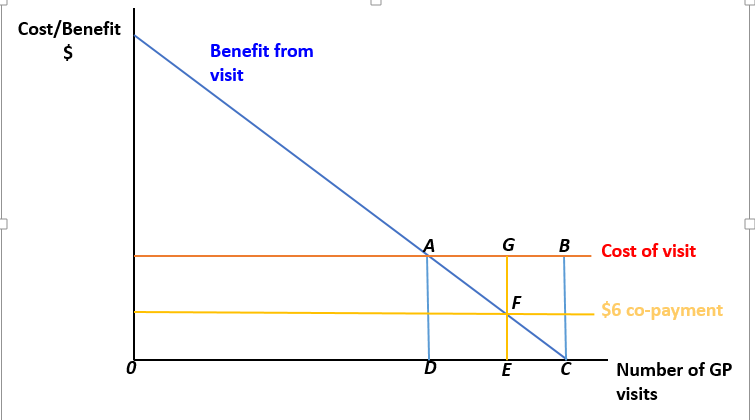
The diagram shows the demand for GP visits. When there is no charge to visit the GP then there will be 0C visits. 

The problem is the cost of providing the GP service for all visits over 0D is greater than the benefit gained. (The benefit may be gained by the patient or society as a whole.) 

For simplicity I am assuming all GP visits cost the same amount. The benefits of each visit vary, some contain infectious diseases and save lives, however some might simply need the advice of a pharmacist and add little benefit.

The GP visits D to C cost the Medicare system ABCD (price x quantity) to provide, but only benefit society by the amount ACD. 

So the logic of the co-payment is this. By introducing the $6 charge E to C visits are perceived by the patient to be not worth the expense. The patients lose the benefit FEC. However the government save the cost GBEC, a substantially greater saving for the benefit lost.

The drawbacks of the co-payment system are obvious. here are just two:
1. The system is regressive. As the lowest paid will pay the same as the best paid the $6 represents a higher percentage of their income. This affects the goal of equality.
2. As health care is an imperfect information good patients are not well placed to decide if going to the doctor is a sensible thing. Some will keep the $6 and miss the chance of the early diagnosis and treatment of a serious illness.


Wednesday, 2 April 2014

Time to start the debate on tax?

The government worries about the size of the budget deficit and is going to take steps in the Budget to fix that. The problem is that short term changes won't fix a long term structural problem.

There are two ways to balance a budget.
1. Cut government spending
2. Raise more revenue through taxes.

Let us suppose that over time a government aims to balance its budget. That is it spends as much as it raises so there is no net addition to the national debt.

This does not mean that in each financial year the government will balance its budget. It actually means in years of low economic activity they will borrow (to boost the level of national output) and in the years at the top of the economic cycle they will run a surplus to repay debt. The result is a balanced budget over the economic cycle.

The problem for Australia is that they are borrowing in most years, resulting in a budget deficit over the economic cycle (known as a structural budget deficit). Although as the chart below shows Australia has no real debt problem compared to other nations.


Australia does not tax its citizens much either when compared to other developed countries (26.5% of GDP compared to an OECD average of 34.1% in 2012). It also has a fantastically complicated tax system which sees most people getting tax rebates each year.

A solution is to expand the tax base by taxing more things and doing this in a simple, non-refundable way. That is by taxing spending, not income. In Australia this is done by using the Goods and Services Tax (GST).

There are two ways the GST can raise more money.
1. Put the rate up from 10%.
2. Extend the range of goods and services GST is applied to.

The advantages of GST are that it is pretty difficult to avoid, so raises a lot on money and is simple to administer.

The disadvantage is that it is a regressive tax. The poor pay a higher proportion of their income in GST than the rich. It is not as easy to compensate the poorer households for this (while it is easy for income tax) and so it adversely affects the goal of a equity in the distribution of income.


Tuesday, 11 March 2014

Time to remember the Henry review

Australia's tax system is a mess. Quite shambolic in fact, with lots of concessions to special interest groups that only make sense in the pursuit of votes. Undoing this mess is politically difficult, because it will lose votes.

The Henry Review of 2010 tried to make sense of the system and suggest sensible reforms. Henry's ideas were welcomed, but little has been done to implement them, except for the changes that accompanied the Carbon Tax (such as the significant rise in the tax free allowance).

Now Mr Henry has suggested that the government might like to look at his proposals again as they try to tackle what they have termed a 'budget emergency'. 

Among other things Henry suggested that GST should be widened and raised. Not a popular move at all. However his point was that taxes should be simple and fair, and a sales tax is both transparent and simple, although not always fair as it is usually regressive.

It would be a good opportunity to remember what the Henry Review suggested and use it as a yardstick to judge any current proposals. the Executive Summary is linked below.

Here is something to think about. What sort of tax system allows the authorities to knowingly take more tax from a person than they owe and then makes them claim their own money back up to a year later? And what sort of tax system allows a landlord to claim tax relief on a loss, even when they bought a property knowing they would make a loss on the rental? The answer is Australia's tax system.