Showing posts with label Imperfect information goods. Show all posts

Wednesday, 3 August 2016

South Australia places 15% tax on gambling

Australia is unusual among developed countries, it does not tax gamblers. This is unusual for two reasons, firstly gambling is a demerit good, and secondly Australians gamble a lot and it is unusual for a government not to take advantage of taxing a popular activity.

Statistically Australians are the worst gamblers in the world. The chart below shows this.


The problem with gambling is that it represents a market failure because gambling is a demerit good and an imperfect information good.

Gambling is a demerit good because:
The actions of the gambler affect third parties, such as their families. This is a negative externality of consumption.
The result of gambling can place costs on others to help gamblers rehabilitate.

Therefore there are negative external costs associated with gambling.

Gambling is an imperfect information good because gamblers rarely understand the full effects of their actions on themselves. They gamble because they hope to win  in a system where the odds are designed to ensure overall gamblers loose. While short term gains are possible over time gamblers loose in aggregate.

The market situation is shown in the diagram below.
The idea of taxing gambling is therefore a good one. Taxes will move a market towards the social optimum (MSB = MSC at Qopt in the diagram.)

The real question is, will the South Australian tax work to solve the market failure? Will those who gamble realize that the price of betting has risen? Is the demand for gambling going to prove so inelastic that there is little change in behaviour (it is an addiction). Also will taxing the firms in this way simply lower profits of bookmakers rather than affect individual behaviour.

Monday, 25 January 2016

Tax reform is a current issue

The Australian government has a budget problem. It's not always the problem they claim it to be so quickly here are the key problems:

1. The government does not raise enough money.  All budgets are a balance between income and revenue. Presently there is a budget deficit because successive Australian governments cut taxes and allowed some groups to have tax concessions which are politically difficult to remove.

2. The population of Australia is ageing. This will lead to the need to higher government spending in the future on services such as health and on benefit payments, such as pensions. There is also the likelihood that the working population will shrink, meaning fewer workers are available to pay the tax needed to raise revenue.

3. Commodity prices are falling. Australia relies on commodity exports to maintain its standard of living. The collapse in iron ore and coal prices means both Australia income and government tax revenue is falling.

Therefore action must be taken to establish a guaranteed revenue stream for the government. Reforming Australia's appallingly complex tax system, which has many built is advantages for vested interest groups, is essential. Everyone agrees on this point!

Th problem for politicians is that they can loose support if they upset voters by asking them to pay more. Therefore they are reluctant to make the tough calls.

One suggestion is that GST is raised to 15%, making everyone pay more. There are pros and cons.

Pros: GST is difficult to avoid, you pay it as you spend. It is cheap to collect, firms do a lot of the work for you and raising the rate makes little difference to collection costs. People don't notice when they pay it, it's in the price, so you get fewer complaints.

Cons: The tax is regressive. That means that the burden falls more heavily on the lower paid (lower income quintiles/deciles of the population) and so works against the goal of equity. If placed on goods with external benefits (positive externalities) it makes market failure worse.

An additional point is that if not applied equally on all goods it changes relative prices. Therefore goods without GST become more attractive to consumers and more resources are allocated to them, with fewer resources going to taxed goods. (This is how taxes work!) However an inefficient allocation of resources can result while the government are trying to do the right thing.

The Treasurer, Scott Morrison, is struggling with all of this as he prepares his first Federal Budget. He is concerned, according to the article below, with the effect of GST on Education and Health. Both are 'Merit goods' and they have external benefits. We wish to encourage increased consumption of both, not reduce consumption through tax.


How Australia deals with the 'Budget crisis' is going to be a vital topic for VCE economists and a case study for IB students.

Questions.
1. What is the effect of raising GST on the distribution of income? (Goal of equity)
2. How does putting GST on health differ from putting GST on education? (Hint. Only private education will attract GST.)

Sunday, 10 August 2014

Education cuts - short term gain for long term disadvantage?

The government can't get over its preoccupation with the Budget deficit. Despite the fact that the deficit is both tiny and completely manageable they insist on cutting government spending. 

In one way their determination is admirable if they truly believe that the accumulated debt will harm Australia in the long run. However their decision to cut education funding can do nothing but harm Australia in the long run.

The Guardian article below has most of the details. The essence of it is that the price of going to university in Australia will go up if the measures ever pass the Senate and so fewer Australian people will go to university.

The real problem is that the people who won't be able to afford to go are exactly the ones that need to. They will come from lower and middle socio-economic groups who have traditionally gone into low tech and manufacturing employment. 

Australia's future prosperity depends on building a better educated workforce able to compete in the global 'knowledge based' economy. For that it needs well educated graduates and a key feature will be getting more people through degree courses. This will help shift the Long Run Aggregate Supply curve to the right that much faster than otherwise and will assist in maintaining non-inflationary growth.

Of course raising the low standard of Australian degrees is out of the question under this scheme. All students must do honours to compete globally. To cut education funding as proposed makes no sense at all.

Monday, 28 April 2014

The economics of Medicare co-payments

It seems likely that the Federal Budget will introduce a $6 charge for visiting the GP when bulk billing is the way the GP is paid. In other words the patient hands over $6 when they visit.

The aim of the measure is to reduce the cost of Medicare to the government. There are two reasons the government want to do this:

1. To reduce expenditure and so reduce the budget deficit.
2. To offset rising Medicare expenditure.

The second reason is the one which needs explaining. As the population of Australia gets older on average there will be greater calls on medical services. Old people get ill more often and medical science finds more and more ways to keep people alive. That's great for the people, but expensive for Medicare.

The problem with free GP visits is that some of them are not necessary, or benefit the patient little. The aim of the co-payment is not so much to raise money as to cut out some of these visits.
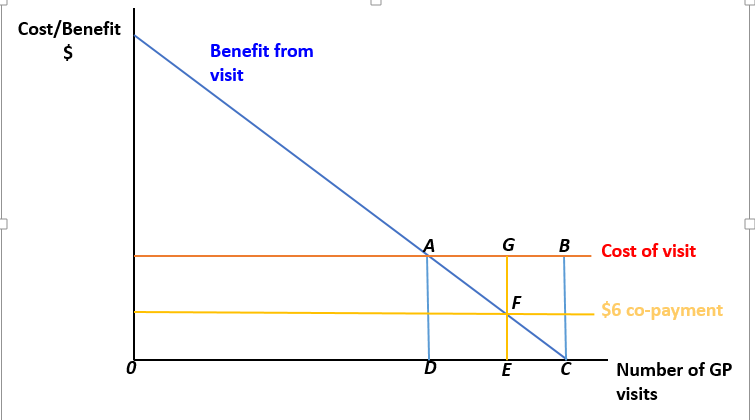
The diagram shows the demand for GP visits. When there is no charge to visit the GP then there will be 0C visits. 

The problem is the cost of providing the GP service for all visits over 0D is greater than the benefit gained. (The benefit may be gained by the patient or society as a whole.) 

For simplicity I am assuming all GP visits cost the same amount. The benefits of each visit vary, some contain infectious diseases and save lives, however some might simply need the advice of a pharmacist and add little benefit.

The GP visits D to C cost the Medicare system ABCD (price x quantity) to provide, but only benefit society by the amount ACD. 

So the logic of the co-payment is this. By introducing the $6 charge E to C visits are perceived by the patient to be not worth the expense. The patients lose the benefit FEC. However the government save the cost GBEC, a substantially greater saving for the benefit lost.

The drawbacks of the co-payment system are obvious. here are just two:
1. The system is regressive. As the lowest paid will pay the same as the best paid the $6 represents a higher percentage of their income. This affects the goal of equality.
2. As health care is an imperfect information good patients are not well placed to decide if going to the doctor is a sensible thing. Some will keep the $6 and miss the chance of the early diagnosis and treatment of a serious illness.


Monday, 17 March 2014

Market Failure and a lack of information

The most common cause of market failure is a lack of information. For example not knowing the full social costs of consuming tobacco or alcohol. Another very serious market failure is asymmetric information, when one party knows more than the other.

If a seller knows more about a good than the buyer then a price can be struck that exceeds the fair value of the good. Good examples are second hand cars and shares in companies.

In Europe there were huge problems with financial advisers selling financial services that were not appropriate for their customers. The financial advisers sold products which maximised their commission, which was not disclosed to their clients, and were often not what the client needed. This was therefore heavily regulated in the early 1990's with full and written disclosure required.

Australia has caught up with legislation and this has recently been enacted or is coming in to force in the next year.

It is remarkable that the idiot Abbot wishes to stop this legislation as he considers it superfluous. He states that "..because it was already an “ethical given” that professional advisers would take into account the best interests of their clients." So he completely ignores all of the evidence of mis-selling from around the world and Australia.

It is perhaps too easy to poke fun at a simple minded man like Abbot, and maybe unfair to say that this is a case of a right wing government helping out its paymasters. However it is a shocking example of a government failing to protect its people from a known market failure.

Sunday, 23 February 2014

Medicare - safe in their hands?

The government is talking about Medicare being 'too expensive' and are preparing to find ways to cut expenditure or raise more revenue.

Australia came to funding public health care in the 1970's, about 25 years after the UK. Why is that relevant? Australia claims Medicare was based on the British National Health Service, a dubious claim at best.

It is important to understand why medical care is provided by government. Health care is an imperfect information good and is often referred to as a merit good. The market will not provide the optimal quantity of health care because consumers don't fully appreciate the value of it.


The diagram shows the situation for health. The true value of health care is given by the red demand curve MSB, but consumers only see the value to themselves as the blue demand curve MPB.

For example when somebody decides to have a flu vaccination they do so to prevent them catching the virus, but don't consider how this also helps stop the flu from spreading to others. Therefore some people don't get vaccinated because they only consider their own benefits against the cost.

The result is that the market only provides 0Q1 units of health care and not the market optimal quantity 0Q*.

So governments subsidise health care, reducing the price to people so they are prepared to seek more medical advice and undergo more treatments. This helps raise overall welfare as people miss fewer days of work, seek preventative medical treatment and so avoid more serious illness and prevent epidemics through vaccinations.

The debate on Medicare will now rage. However it is important to remember that Medicare is not the comprehensive, "free at the point of use" system the UK offers. A comparison of the two would be instructive.