OPEC is a group of countries that produce oil and in the 1970's formed a cartel to try and raise the revenue they received from oil production. They were very successful then, but today there are many oil producers who are not members of OPEC and so their ability to influence the market has declined.
There is more oil production capacity than there is demand, and presently more oil is produced than the market wants. This situation of excess supply has depressed oil prices.
OPEC has tried to reduce supply from its members, with the cooperation of a few other countries, in order to raise oil prices. They succeeded, but the agreement is running out and there is talk of extending it.
There are some useful areas to investigate.
1. The oil price has fluctuated in anticipation of the agreement being renewed and to news about the level of oil stocks. Why?
2. The members of OPEC have an incentive to agree production limits and then cheat by producing more. Is this always true in cartels?
3. Why is the oil market producing so much more than the market requires? (The move away from fossil fuels and the rate of economic growth are both relevant here.)
4. Who gains and who loses from the lower oil price?
Showing posts with label Expectations. Show all posts
Showing posts with label Expectations. Show all posts
Monday, 27 March 2017

Tuesday, 11 October 2016
The UK pound continues to fall
The exchange rates for the currencies of most developed countries are 'free floating'. That is the value of the currency is determined by demand and supply in the foreign exchange market.
The foreign exchange market works to a great extent like any other market. The price of the currency rises when demand for the currency rises or supply falls. On the level of trade this means that when anyone wants to import, say British, goods they demand the pounds they need to pay British firms who supply them. There is then a market in pounds with those buying British goods and services demanding pounds and Britons selling pounds in order to gain the currency they need to import goods and services from other nations.
There is another aspect to currency markets however. The currency itself can be an asset and also a medium to invest in another country. Some people will want to invest their money in a country to get a higher return than they could elsewhere. Others will hold currency in order to make a capital gain, that is buy low and sell high.
This second reason to buy and sell currency makes the expectation of the future value of a currency very important. If you expect the value of a currency to fall you sell it before it does, this avoids a capital loss and prevents the advantage of getting a better interest rate being wiped out by the falling value of the currency.
Since Britain voted to leave the EU (in a travesty of a referendum) the pound has been falling in value.

The foreign exchange market works to a great extent like any other market. The price of the currency rises when demand for the currency rises or supply falls. On the level of trade this means that when anyone wants to import, say British, goods they demand the pounds they need to pay British firms who supply them. There is then a market in pounds with those buying British goods and services demanding pounds and Britons selling pounds in order to gain the currency they need to import goods and services from other nations.
There is another aspect to currency markets however. The currency itself can be an asset and also a medium to invest in another country. Some people will want to invest their money in a country to get a higher return than they could elsewhere. Others will hold currency in order to make a capital gain, that is buy low and sell high.
This second reason to buy and sell currency makes the expectation of the future value of a currency very important. If you expect the value of a currency to fall you sell it before it does, this avoids a capital loss and prevents the advantage of getting a better interest rate being wiped out by the falling value of the currency.
Since Britain voted to leave the EU (in a travesty of a referendum) the pound has been falling in value.

The Pound against the US$ October 2015 to October 2016
The sharp fall on the day after the Brexit vote on June 23rd is clearly visible and so is the continued fall of the past two weeks.
The article linked below gives some reasons for this in particular. In summary these are:
* Concerns that the UK economy will grow more slowly.
* Concerns that the UK will not have free access to the EU single market after Brexit
* That interest rates will not rise in the UK to prevent further domestic contraction (relative interest rates fall)
* Concern that holding pounds will lead to a capital loss, due to the above reasons, so best to sell now.
Note the importance of expectations and risk in this system. It is crucial to behaviour.
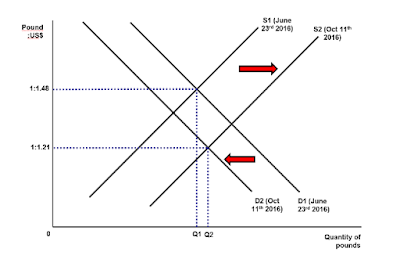
The diagram below shows how the foreign exchange market for the pound might have behaved since June. Fewer buyers (who buys a currency with a way to fall leaving just 'trade' demand) D1 to D2 and more sellers (investors leaving for safer currencies) S1 to S2.

Note the links within the article that are worth exploring.
As this story is about the UK pound (GBP) this is most useful for IB students on how the floating exchange rate mechanism works. However VCE students should realise that the Australian dollar has the same floating system.
Thursday, 29 May 2014
Dollar movements highlight a 'patchwork economy'
The Australian dollar took a move upwards on seemingly bad news. Investment in capital goods was down.
The reason why the dollar got stronger was that investment in the manufacturing sector was up. An unexpected event. This is seen as good as Australia tries to get over dependence on the mining boom.
Not that long ago it was fashionable to talk about a 'two speed economy'. The mining sector forged ahead, driving overall GDP growth, while manufacturing shrank. It was more accurate to describe a 'multi-speed' or 'patchwork' economy as different states and industries met very different fortunes.
So this is good news of sorts, but still points to an overall downward trend in Investment (a component of Aggregate Demand).
The story does help us understand important influences on the exchange rate. To understand why the exchange rate changes on this news is important:
1. The exchange rate is determined by the demand for and supply of the Australian dollar.
2. A major reason to demand Australian dollars is to buy iron ore (Australia's largest export) and the price of iron ore has fallen 28% in the last year. Therefore buyers need fewer dollars and so demand for dollars falls.
3. Another reason to buy dollars is to invest in Australian businesses. If an economy is growing strongly the chance making a profit is higher.
4. The new figures on investment in manufacturing imply that Australia will grow faster than was previously expected.
5. Therefore confidence in Australian future profits has risen, this will mean greater demand for investing in Australia in the future, and so the demand for dollars rises now.
6. Demand for Australian dollars rises now because some speculators will expect the dollar to be worth more in the future and they seek to buy dollars now to make a profit reselling them later.
It's easier on a diagram!
The reason why the dollar got stronger was that investment in the manufacturing sector was up. An unexpected event. This is seen as good as Australia tries to get over dependence on the mining boom.
Not that long ago it was fashionable to talk about a 'two speed economy'. The mining sector forged ahead, driving overall GDP growth, while manufacturing shrank. It was more accurate to describe a 'multi-speed' or 'patchwork' economy as different states and industries met very different fortunes.
So this is good news of sorts, but still points to an overall downward trend in Investment (a component of Aggregate Demand).
The story does help us understand important influences on the exchange rate. To understand why the exchange rate changes on this news is important:
1. The exchange rate is determined by the demand for and supply of the Australian dollar.
2. A major reason to demand Australian dollars is to buy iron ore (Australia's largest export) and the price of iron ore has fallen 28% in the last year. Therefore buyers need fewer dollars and so demand for dollars falls.
3. Another reason to buy dollars is to invest in Australian businesses. If an economy is growing strongly the chance making a profit is higher.
4. The new figures on investment in manufacturing imply that Australia will grow faster than was previously expected.
5. Therefore confidence in Australian future profits has risen, this will mean greater demand for investing in Australia in the future, and so the demand for dollars rises now.
6. Demand for Australian dollars rises now because some speculators will expect the dollar to be worth more in the future and they seek to buy dollars now to make a profit reselling them later.
It's easier on a diagram!
Subscribe to:
Posts (Atom)